California energy costs are rising — lock in savings for your home or business. Get a Free Quote →

Wildfire Crisis Series · Part 1 of 2

Wildfire Crisis Series · Part 1 of 2

Wildfire Crisis Series · Part 1 of 2

Trusted Solar Installation Services in Anaheim

The Commercial Property Owner's Wildfire Debt Mitigation Strategy

🎧 15 min listen · 📖 8 min read · February 2026

0:00/1:34

California's $225 billion wildfire liability isn't a future problem — it's already embedded in every commercial electricity bill in the state. Following the devastating 2025 fire season, Senate Bill 254 established the legal framework that transforms your monthly utility payment from an energy cost into a 40-year debt repayment vehicle.

In this briefing, we break down the exact legislative mechanics, the financial math behind projected rate increases, and the specific line items on your bill where wildfire costs are hiding. Whether you're a commercial property owner, facility manager, or real estate investor, understanding these mechanisms is the first step toward protecting your bottom line.

This is Part 1 of our two-part series. Part 2 covers the specific tax incentives and deadlines for solar adoption before the 2026 window closes.
Listening Guide

Chapter-by-Chapter Breakdown

0:00 – 3:10

The Transition of the Utility Bill

The Transition of the Utility Bill

The Transition of the Utility Bill

Moving from energy consumption billing to a 40-year debt repayment vehicle

Legislative evolution from the original AB 1054 Wildfire Fund to SB 254's Continuation Account

Key Insight

“Your utility bill is no longer just paying for electricity — it's servicing decades of wildfire debt through mechanisms most ratepayers never see.”

Guided Summary

The discussion outlines the fundamental shift in California utility law following the 2025 fires. While AB 1054 established the initial $21 billion fund, SB 254 was enacted to create an “$18 Billion Continuation Account,” extending the ratepayer “mortgage” on wildfire debt through 2045.

3:10 – 6:15

The Rate Hike Mechanics

The Rate Hike Mechanics

The Rate Hike Mechanics

The Shareholder Deductible: $1 billion annual first line of defense before ratepayer exposure

The 1% Anchor: Why $340 million in fire costs equals a mandatory 1% rate hike

The Liability Cap: How the 20% equity rate-base limit protects utility solvency while accelerating fund depletion

Key Insight

“A mere 1% rate increase across the commercial sector extracts approximately $44 million annually from business profits — and that's just the baseline.”

Guided Summary

Utilities must bear the first $1 billion in annual claims from their own profits before accessing the ratepayer-funded Wildfire Fund. Once a utility's liability cap is reached, the utility is shielded from bankruptcy, and the full cost falls directly on the ratepayer-funded pool.

6:15 – 9:20

The 2025 Fire Season Fallout

The 2025 Fire Season Fallout

The 2025 Fire Season Fallout

Analyzing the financial liability from the Eaton and Palisades fires

Inverse Condemnation & Multipliers: The legal mechanics making utilities strictly liable for damages

Key Insight

“Under California's Inverse Condemnation laws, utilities are strictly liable regardless of negligence — every dollar of damage is recovered directly from ratepayers.”

Guided Summary

The Eaton and Palisades fires of January 2025 served as financial “Extinction Events.” Because of California's Inverse Condemnation laws, utilities are strictly liable for damages regardless of negligence, forcing them to recover litigation and settlement costs directly from the ratepayer base.

9:20 – 14:42

The Road to $9.29/kWh

SB 254 Securitization: Using monthly bills as collateral for massive loans through 2045

The Bond Multiplier: Why rate smoothing over 20 years causes ratepayers to pay significant interest

The 2032 “Settlement Spike”: Preparing for the intersection of litigation payouts and fund exhaustion

The 2050 Reality: Rates projected to reach $9.29/kWh

The Three Hidden Buckets: WF NBC, Delivery, and Fixed Recovery charges

The Behind-the-Meter Solution: The only legal way to opt out

Key Insight

“By 2050, sustained compounding is projected to push commercial rates to $9.29 per kWh — and the only legal opt-out is generating power behind your own meter.”

Guided Summary

California uses securitization to smooth wildfire costs over decades — essentially taking out massive loans using your monthly bill as collateral. A critical “Settlement Spike” is projected for 2032, where rates are expected to jump significantly to cover final litigation payouts. By 2050, sustained compounding is projected to push rates to $9.29 per kWh.

$225B

Total wildfire liability socialized across California ratepayers

$9.29/kWh

Projected commercial electricity rate by 2050

45–55%

Share of your delivery charges now dedicated to wildfire costs

2032

Projected settlement spike year — intersection of litigation payouts and fund exhaustion

Listening Guide

Where Wildfire Costs Hide on Your Statement

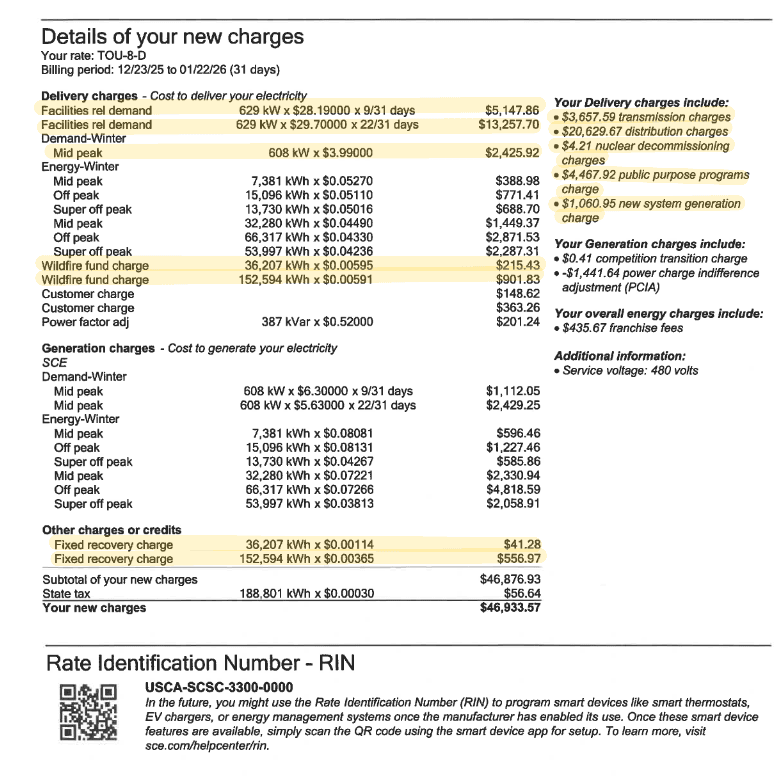
The following charges on your SCE or PG&E bill are the primary mechanisms used to recover wildfire-related debt. Understanding them is the first step toward taking control of your energy costs.

Delivery Charges

While officially labeled as the cost of physical grid maintenance, 45% to 55% of this charge is now dedicated to wildfire-related costs — including grid hardening ($28 billion undergrounding baseline), vegetation management, and wildfire liability insurance premiums that the CPUC authorizes utilities to pass 100% to ratepayers.

Power Charge Indifference Adjustment (PCIA)

A charge ensuring that both current SCE customers and those who have left for other providers pay for “above-market” costs for energy resources SCE purchased on their behalf.

Fixed Recovery Charge

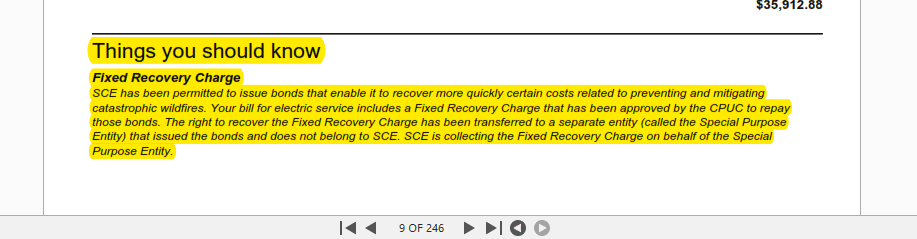
A charge approved by the CPUC to repay bonds issued by a Special Purpose Entity to help SCE recover costs related to preventing and mitigating catastrophic wildfires. Although SCE collects this fee, the right to the recovery has been transferred to a separate entity.

Wildfire Fund Charge

A fee supporting the California Wildfire Fund, including the payment of bonds issued by the California Department of Water Resources (DWR) to fund wildfire liabilities.

Delivery Charges

While officially labeled as the cost of physical grid maintenance, 45% to 55% of this charge is now dedicated to wildfire-related costs — including grid hardening ($28 billion undergrounding baseline), vegetation management, and wildfire liability insurance premiums that the CPUC authorizes utilities to pass 100% to ratepayers.

Fixed Recovery Charge

A charge approved by the CPUC to repay bonds issued by a Special Purpose Entity to help SCE recover costs related to preventing and mitigating catastrophic wildfires. Although SCE collects this fee, the right to the recovery has been transferred to a separate entity.

Power Charge Indifference Adjustment (PCIA)

A charge ensuring that both current SCE customers and those who have left for other providers pay for “above-market” costs for energy resources SCE purchased on their behalf.

Wildfire Fund Charge

A fee supporting the California Wildfire Fund, including the payment of bonds issued by the California Department of Water Resources (DWR) to fund wildfire liabilities.

Listening Guide

Where Wildfire Costs Hide on Your Statement

The following charges on your SCE or PG&E bill are the primary mechanisms used to recover wildfire-related debt. Understanding them is the first step toward taking control of your energy costs.

Review Your Bill for Hidden Wildfire Costs

Look for these specific line items: WF NBC (Wildfire Fund Non-Bypassable Charge), Delivery & Distribution Charges, and Fixed Recovery Charges. These are the primary mechanisms recovering wildfire debt from your business.

Understand the Legal “Opt-Out”

The only legal mechanism to stop paying Non-Bypassable Charges associated with debt recovery is to generate power behind-the-meter. Commercial solar and battery storage achieves “Financial Islanding” — opting out of the compounding inflation of the grid.

Learn from Historical Precedent

The 2001 Energy Crisis saw emergency rate increases of 35%–49% within 12 months. The late 2010s PG&E wildfires resulted in nearly $20 billion in liabilities and created the bond issuance framework used today. The current trajectory follows the same pattern at a much larger scale.

Get Your Complimentary Solar & Storage Assessment

Submit your interval data through our Utility API for a customized proposal that shows exactly how much you'd save by going behind-the-meter before the 2026 tax credit deadlines close.

Sources & References

Reference Bibliography

I. Legislative & Statutory Authority

II. Regulatory Decisions (CPUC) & Utility Filings

III. Financial Data & Historical Precedent

IV. Media & Event References

Ready to opt out of the wildfire debt cycle?

Ready to opt out of the wildfire debt cycle?

Get a complimentary solar and storage assessment for your commercial property.

Get a complimentary solar and storage assessment for your commercial property.

Up Next — Part 2

Maximizing Solar Tax Benefits Before 2026 Deadlines

ITC step-down timelines, bonus depreciation strategies, and construction-start safe harboring — everything you need to maximize incentives before they expire.